Church of Saint
Church of Saint
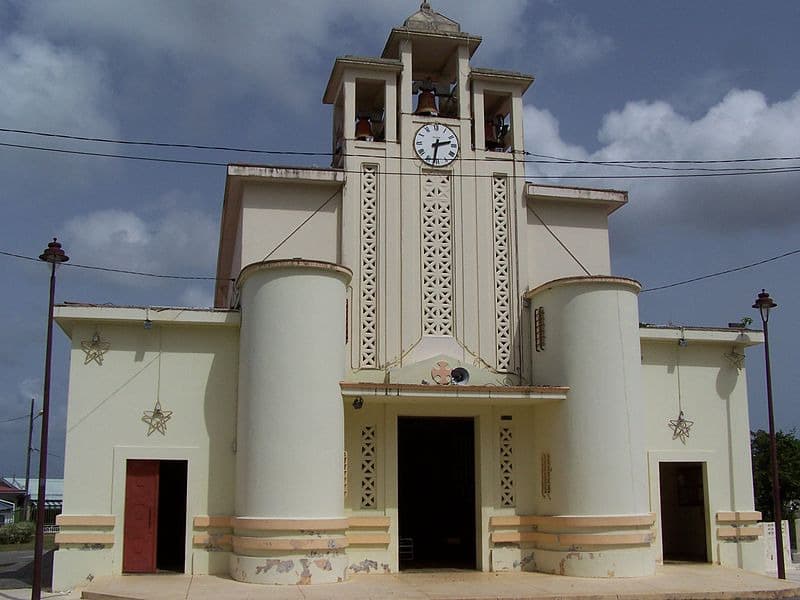
In Baie-Mahault, the Saint-Jean-Baptiste Church rebuilt by Ali Tur after the 1928 hurricane blends Art Deco with Sudanese influences. Listed as a Historic Monument.
On rue du Maréchal-Foch, in the heart of Baie-Mahault, the Saint-Jean-Baptiste Church stands out for its distinctive silhouette: two massive cylinders frame the entrance, a legacy of architect Ali Tur and the modernist architecture of the 1930s. Listed as a Historic Monument and labeled "20th-Century Heritage," it represents one of the finest examples of post-hurricane reconstruction in Guadeloupe.
Why visit the Baie-Mahault church
This Catholic church is no tropical postcard, and that is precisely what makes it compelling. It illustrates a specific moment in Guadeloupe's architectural history: when the island, devastated by the Okeechobee hurricane of 1928, entrusted its reconstruction to an architect trained in mainland France, Ali Tur, who adapted Art Deco principles to the constraints of a tropical climate. The result is a building that is simultaneously understated, functional, and unexpected, where natural ventilation dialogues with geometry inherited from European avant-gardes.
The stop suits travelers interested in built heritage, colonial and postcolonial history, or simply unusual architecture. Plan around thirty minutes to tour the building and observe its details.
A history of multiple reconstructions
It all began in the 17th century with the creation of the Saint-Louis parish, whose first church was built at this location. Of that original edifice, only the façade would survive the centuries. Between 1825 and 1850, the building was entirely reconstructed around this preserved façade.
The turning point came in September 1928, when the Okeechobee hurricane devastated Guadeloupe and severely damaged the structure. Architect Ali Tur, commissioned to rebuild numerous public buildings across the island, took charge of the bell tower, sacristy, presbytery, and its annex. Work took place between 1930 and 1931, at a cost of 850,000 francs. The Fatima Chapel, attached to the complex, completes the site.
Heritage recognition came in 1978: the Baroque façade, main body, bell tower, and presbytery were listed as Historic Monuments. Official classification of the church in its entirety occurred on May 5, 2017. The building also carries the label "20th-Century Heritage," which honors Ali Tur's work.
What to observe on site
A façade signed by Ali Tur
The style blends Art Deco with Sudanese influences, a recognizable signature of Ali Tur's constructions in Guadeloupe. The two large cylinders framing the entrance are surprising: the architect drew directly from North American grain silos, particularly those at the Port of Montreal referenced by Le Corbusier in 1923. Here they take the form of inverted apses affixed to the façade.
At the top, three small bell turrets and a clock are visible. The façade is pierced by three vertical bands of latticework that allow air and light to circulate—an essential feature in the Caribbean climate.
Ternary rhythm and ventilation
The interior is organized around a central nave flanked by two side aisles, each with its own entrance. This ternary rhythm is a constant in Ali Tur's work. Along the side aisles, there are eight sets of tall wooden louvers, always grouped in threes. Above, another row of latticework ensures interior lighting and ventilation.
The floor as reference
On the floor, the tiling plays both a functional and aesthetic role. The deep red, black, and beige tones clearly delineate circulation spaces and areas for contemplation. A detail one only notices by lowering one's gaze, but which structures the entire interior journey.
Practical information
- Address: rue du Maréchal-Foch, Baie-Mahault, Guadeloupe.
- Interior access: the church remains an active place of worship. Visits are free outside of services, but it is advisable to check with the parish for opening hours, which may vary.
- Dress code: appropriate attire requested, as in any active place of worship.
- Duration of visit: 20 to 40 minutes are sufficient to tour the exterior and interior.
- Fee: free admission.
How to get there
Baie-Mahault is located about ten kilometers west of Pointe-à-Pitre, on Grande-Terre. From Pôle Caraïbes Airport or downtown Pointe-à-Pitre, allow approximately 15 to 25 minutes by car depending on traffic, which can be particularly heavy during rush hours due to the Jarry industrial zone. The church is located in the town center, where parking is available on adjacent streets. Regional bus services also connect Baie-Mahault to Pointe-à-Pitre.
Nearby attractions
A stop in Baie-Mahault can be incorporated into a broader island itinerary. Several sites are worth visiting nearby or on the same day:
- The Damoiseau distillery, a few kilometers away in Le Moule, for a tour focused on agricultural rum.
- The Factory Plant, a former sugar industrial site converted for new uses, to continue exploring built heritage.
- The Carbet waterfalls, on Basse-Terre, to transition to the island's natural landscapes.
- Fort Napoléon, on Terre-de-Haut, accessible by shuttle from Trois-Rivières or Pointe-à-Pitre.
Extending your visit
The Saint-Jean-Baptiste Church is part of a broader Guadeloupe heritage, marked by the reconstructions of the 1930s and the works of Ali Tur scattered throughout the archipelago. To build a stay that combines architecture, history, and landscapes, explore our suggested itineraries on our dedicated Guadeloupe page.
Interested in this visit?
We can include it in your personalised itinerary.