Geography of Guadeloupe
A top destination for travelers worldwide, the Guadeloupe archipelago is an Overseas Department of France, nestled between the Atlantic Ocean and the Caribbean Sea. Located in the Caribbean archipelago, it sits at the heart of the Lesser Antilles.
A top destination for travelers worldwide, the Guadeloupe archipelago is an Overseas Department of France, nestled between the Atlantic Ocean and the Caribbean Sea. Located in the Caribbean archipelago, it sits at the heart of the Lesser Antilles. Discover more about Guadeloupe and its geographical features that never fail to impress visitors.
Country Overview
The Guadeloupe archipelago, including the island of Guadeloupe and its dependencies, spans 1,702 km².
The Island of Guadeloupe
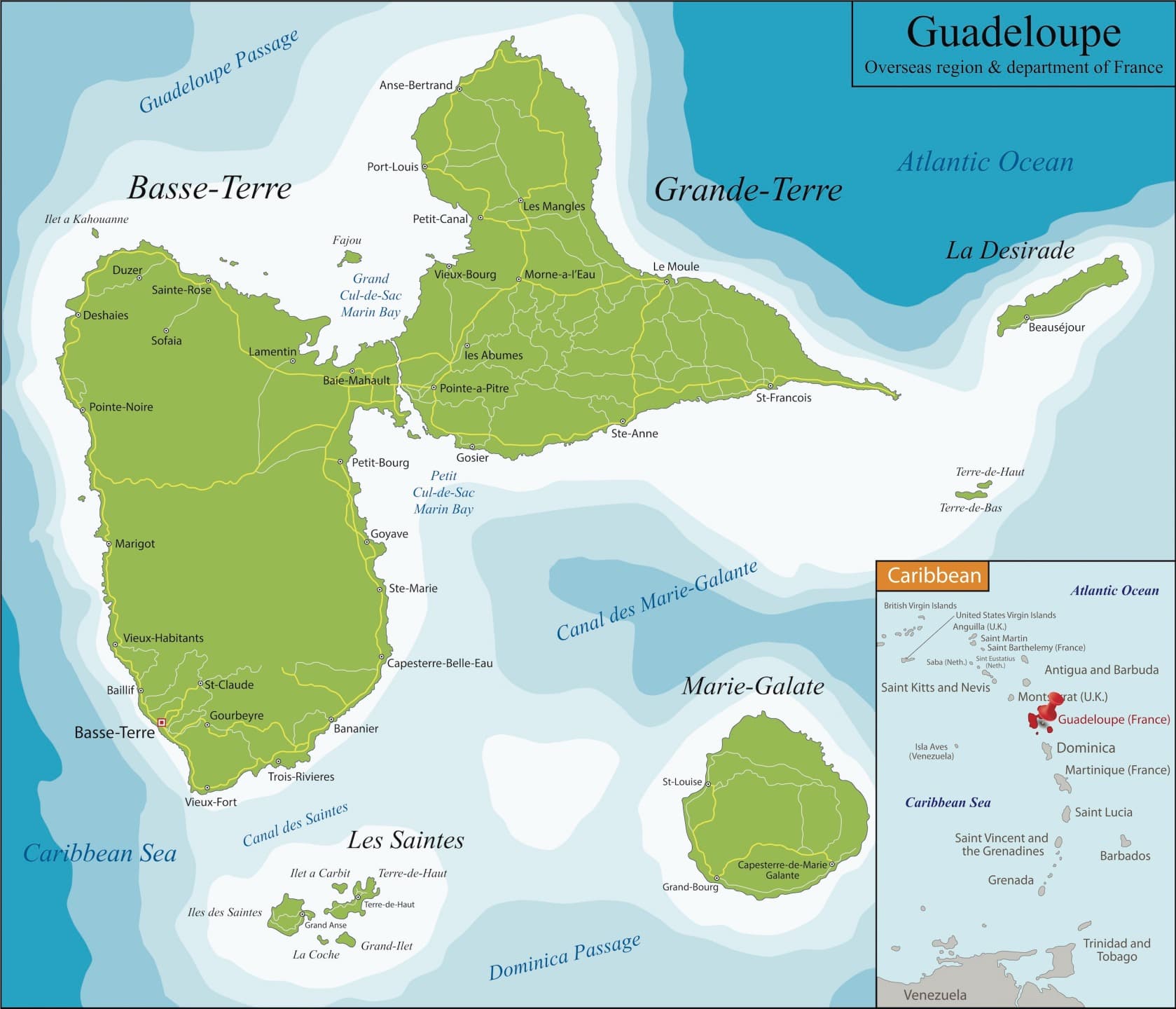
Guadeloupe stricto sensu, or continental Guadeloupe, covers an area of 1,438 km², making it the largest island of the French Antilles. Geographically, it takes the shape of a butterfly with spread wings—hence the country's nickname: "the butterfly island." These two wings are separated by a narrow strait less than 200 meters wide called "Rivière Salée," with Grande Terre representing the eastern wing and Basse Terre to the west.
Grande Terre
Grande Terre stretches across a flat expanse of 590 km² with a limestone substrate. It comprises an arid plateau indented with rugged, wild rocky coasts and sugarcane plantations in the north. A plain bordered by mangroves characterizes its southwestern side. In its central area, irregular hills known as "Grands Fonds" rise in succession. Major beach resorts and magnificent white sand beaches sheltered by coral reefs line the southern coast, known as the "Riviera" of Grande Terre.
Basse Terre
Basse Terre (or Guadeloupe proper), a mountainous, forested, and volcanic region, covers 848 km². A verdant paradise, it is blanketed in dense tropical rainforest from north to south and dotted with numerous rivers and stunning waterfalls. It is home to the highest peak of the Lesser Antilles, the La Soufrière volcano, rising to 1,467 meters in altitude. Basse Terre's landscape is characterized by numerous black sand and rust-colored sand beaches, typical of volcanic regions.
Administrative Dependencies
The combined area of all the southern islands, or Guadeloupe's administrative dependencies, totals 194 km². These islands differ somewhat from the main island of Guadeloupe in terms of culture, heritage, history, and lifestyle.
Marie Galante, the largest of all, covers a limestone area of 158 km². Due to its round shape, it is nicknamed "the Great Galette."
The Saintes archipelago is composed of 9 islets, of which only 2 are inhabited: Terre-de-Bas covering 8 km² and Terre-de-Haut at 5 km², totaling 14 km².
La Désirade is an elongated island of 22 km² presenting itself as a large limestone plateau inclined toward the northwest.
Petite Terre, designated a Natural Reserve, is a small microcoral archipelago of 2 km² located between La Désirade and Les Saintes. Nestled approximately 10 km southeast of Pointe des Châteaux in Saint-François, it comprises two islands: Terre de Bas and Terre de Haut. Petite Terre is home to Guadeloupe's oldest lighthouse.
Geographical Location
Situated 6,200 km from mainland France, Guadeloupe lies at the heart of the Lesser Antilles arc. It is:
- 2,200 km southeast of Florida
- 600 km off the coasts of South America
- 2,200 km from North America
- 1,900 km from Central America
Fauna and Flora
Several thousand hectares of tropical rainforest cover three-quarters of the butterfly island. Guadeloupe's tropical fauna is characterized by the presence of the Lesser Antilles iguana and the common iguana, along with Guadeloupe's mascots (a type of raccoon abundant in Guadeloupe National Park), lizards (margouillats, anoles, etc.). Mongooses, scorpions, centipedes (a painful-stinging relative of millipedes) and land crabs make up its terrestrial fauna. In Guadeloupe, you can observe hummingbirds, large terns, pipirites, and pelicans. Fish come in every color and species imaginable: barracudas, snappers, boxfish, moray eels, rays, sea urchins, and more.
Rich in 300 species of trees and 100 species of orchids on record, Guadeloupe's flora features numerous banana plantations, sugarcane estates, pineapple farms, and breadfruit trees. You will also encounter mangroves, coconut palms, coffee plants, cacao trees, royal palms, traveler's palms, and more. Since the flora is tropical and abundantly lush, it offers countless varieties of tropical fruits such as papayas, star fruits, mangoes, guavas, lemons, yams, and others. To top it off, you'll find Guadeloupe National Park at the center of Basse Terre.
A Note on Geology
Guadeloupe's territory has two different geological origins. Basse Terre and the Saintes stem from recent volcanic chain formations that peak at La Soufrière. The other Guadeloupe islands, however, are of coral origin. Its geological characteristics place Guadeloupe and its dependencies in seismic zone III according to France's seismic zoning standards under previous regulations, and level 5 under current standards.